
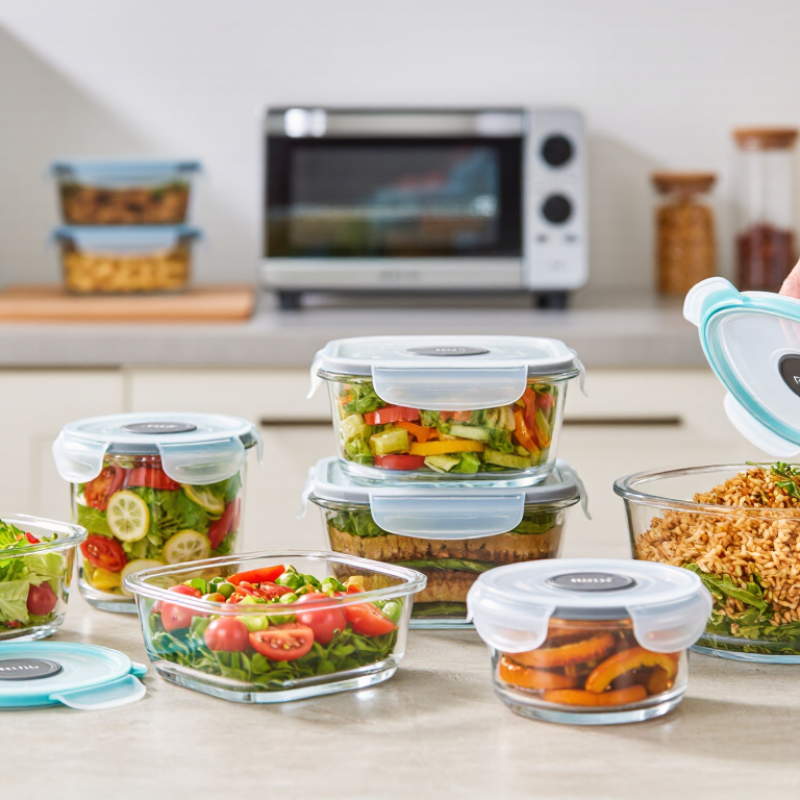
7 Tips for Choosing Glass Food Containers
Tip 1
Identify the glass type before judging heat resistance. Borosilicate glass often has a low expansion coefficient near 3.3 × 10⁻⁶/K. Soda-lime glass may reach about 9 × 10⁻⁶/K. Lower expansion usually means better resistance to sudden temperature changes. It does not guarantee unlimited safety.
Tip 2
Check the manufacturer’s thermal limits. Look for approved oven, microwave, freezer, and dishwasher temperatures.
Tip 3
Examine the container for chips, scratches, or cloudy areas. Small damage can become a failure point during heating. I once underestimated a hairline crack. That was a useful mistake.
Tip 4
Avoid extreme temperature jumps. Do not move a frozen container directly into a hot oven. Let it warm gradually. Thermal stress develops when different parts expand at different speeds.
Tip 5
Confirm whether the lid has separate limits. Plastic, silicone, and metal parts may tolerate different temperatures. Never assume the lid matches the glass.
Tip 6
Choose thick, evenly formed walls for everyday storage. Uneven thickness can create concentrated stress.
Tip 7
Read care instructions, even when the glass seems laboratory-grade. The number 3.3 or 9 describes expansion, not complete product performance. Manufacturing quality, shape, scratches, and heating speed also matter. A lower coefficient is helpful, but it is only one part of a reliable decision.
