
How to Find Top Wholesale Glass Food Containers in China?

Time:2026-10-20 Author:Mason
0%

Finding reliable wholesale glass food containers in China requires more than comparing factory prices. Buyers must examine materials, production controls, testing records, and communication quality. A polished catalog proves very little. The real evidence appears in samples, specifications, and factory responses.

Dr. Jane Muncke, a food-packaging scientist and Managing Director of the Food Packaging Forum, has stated, “We need to move away from the idea that chemicals are safe until proven harmful.” Her warning matters when evaluating containers, lids, coatings, inks, and silicone seals. Glass may contact food directly, but the complete packaging system still requires careful review. Ask suppliers for glass type, temperature limits, food-contact documentation, and migration-test reports. Check whether the documents match the actual factory and product model.

Practical experience also exposes smaller details. A sample jar may look excellent, yet its lid can smell strongly after washing. A thick base can survive heating, but a sudden temperature change may cause breakage. Request several samples, test them with oil, soup, freezing, and repeated cleaning. Record defects rather than trusting memory. It is easy to overfocus on the lowest quotation. That can become an expensive mistake.

This guide explains how to compare Chinese manufacturers, verify production capability, and negotiate sensible terms for wholesale glass food containers. It also considers minimum order quantities, packaging protection, customization, lead times, and shipment consistency. No supplier is perfect. Your evaluation process should leave room for doubt, testing, and revision. Reliable sourcing begins when assumptions are replaced with measurable evidence.
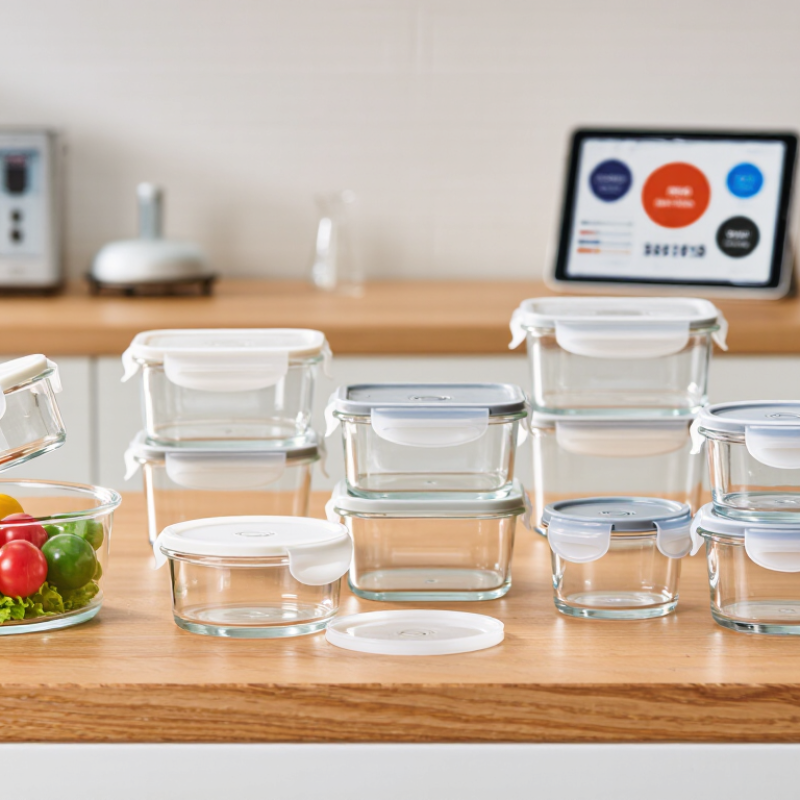
How to Find Top Wholesale Glass Food Containers in China?

Define Requirements: Capacity, Dimensions, Lids, MOQ, and Target Use

When sourcing wholesale glass food containers in China, define the product before contacting factories. Record the required capacity, such as 500 ml for lunch portions or 1,000 ml for family meals. Add exact length, width, and height measurements. Remember that glass thickness can affect the internal volume.

Specify the lid clearly. Do you need a leak-resistant seal, snap-lock tabs, or a simple cover? State whether the container will enter a microwave, freezer, oven, or dishwasher. These uses affect glass type, lid material, and temperature limits. Ask for food-contact test reports and written care instructions. Keep those records.

Your target use also determines the order quantity. A restaurant chain may need consistent cartons, while an online seller may test a smaller MOQ. Request samples with the final lid and packaging. Check the rim for chips, the base for wobbling, and the seal after several opening cycles. Measure each sample yourself. I once trusted a supplier’s listed dimensions and found the usable space smaller than expected.

Discuss carton strength, pallet loading, replacement rates, and production lead time. Confirm whether the quoted MOQ applies per size, color, or complete shipment. Factory photos help, but an independent inspection provides stronger evidence. Ask direct questions. Vague answers deserve caution. My specifications are never perfect on the first draft, so I revise them after testing real meals and storage conditions.

Compare Glass Types: Borosilicate 3.3 Versus Soda-Lime for Thermal Performance

When sourcing wholesale glass food containers in China, thermal performance should guide your comparison. Borosilicate 3.3 glass contains boron oxide and has a very low thermal expansion rate. It handles sudden temperature changes better. This matters when containers move from a refrigerator to a heated oven. Soda-lime glass is more affordable and widely available. However, rapid temperature changes can create stress, especially in thick or uneven walls.

In supplier audits, I check the glass specification, wall thickness, edge finish, and heating test records. A container may claim heat resistance, yet its lid, corners, or molded seams can remain vulnerable. Borosilicate 3.3 is usually the safer choice for meal preparation and repeated heating. Soda-lime can work well for dry storage, room-temperature meals, and cost-sensitive orders. Still, the final performance depends on design quality, not glass type alone. I have seen poorly finished borosilicate containers fail earlier than carefully made soda-lime products. That finding deserves attention.

Tips: Request samples from each production batch. Test them with cold food, hot water, and controlled heating. Do not pour boiling liquid into a chilled container. Ask for thermal shock data, food-contact test reports, and packaging details. Check whether the supplier can maintain consistent thickness across large orders. A small sample can hide production variation. Use several samples instead.

Verify Compliance: FDA 21 CFR 177.1630, EU 1935/2004, and GB 4806

How to Find Top Wholesale Glass Food Containers in China?

Compliance verification should guide every wholesale purchase. FDA 21 CFR 177.1630 covers glass articles intended for food contact. Check whether the supplier’s test scope matches your container, lid, coating, and intended food types. The EU Framework Regulation 1935/2004 requires food-contact materials to avoid harmful migration and unacceptable changes in food. It also supports traceability through the supply chain. For China, review the applicable GB 4806 requirements, including GB 4806.5 for glass products. Do not accept a general “food-grade” statement. Paperwork is not proof.

Request recent migration reports from an accredited laboratory. Confirm the tested sample matches the production model, including color, printing, silicone seals, and metal parts. Ask for test conditions covering hot filling, freezing, acidic foods, and repeated use when relevant. Check batch codes, raw-material records, and factory inspection procedures. A capable supplier should explain how rejected glass is isolated and how complaints are investigated. Test the finished set.

A certificate may look impressive but still miss a critical component. This is where sourcing teams often make mistakes. I would record every requirement in a compliance matrix and compare it with the purchase specification. Requirements can change by market and use. Verify the current rules with a qualified testing body before shipment, especially when the product includes decoration or unusual closures. Details matter.

Evaluate Suppliers: MOQ, ISO 9001, Lead Times, and AQL 2.5 Limits

Finding top wholesale glass food container suppliers in China requires more than comparing prices. Start with MOQ details for each size, lid type, color, and custom package. A supplier may quote 3,000 pieces, but each variation could require a separate MOQ. Ask whether the MOQ applies to one shipment or one production run. Request recent production photos, factory audit records, and food-contact test documents. These details reveal practical experience, not just polished sales claims.

ISO 9001 shows that a supplier follows a documented quality management system. It does not guarantee flawless glass or safe lids. Check the certificate’s validity, issuing body, and production scope. Then discuss lead times in writing. Separate sampling, tooling, production, inspection, and shipping time. For example, a 500 ml container order may need extra days for mold changes. Confirm how the factory handles delays and damaged cartons. I have seen “15-day delivery” exclude inspection and packaging preparation.

AQL 2.5 must be clearly defined before ordering. It is a sampling limit, not permission for every shipment to contain 2.5% defective units. Agree on inspection levels and defect categories. Chipped rims, cracks, sharp edges, and leaking lids need stricter treatment than small surface bubbles. Ask for the sample size, acceptance number, and rejection procedure. Include photos in the quality agreement. I once focused too heavily on the AQL figure and overlooked carton compression. That mistake taught me to inspect the whole delivery system, not only the glass.

How to Find Top Wholesale Glass Food Containers in China? — Evaluate Suppliers: MOQ, ISO 9001, Lead Times, and AQL 2.5 Limits

Supplier Profile Typical Product Scope MOQ per SKU ISO 9001 Status Standard Lead Time Sample Lead Time AQL 2.5 Inspection Requirement Packaging and Compliance Evidence Evaluation Result
Profile A
High-volume glassware factory
Tempered soda-lime glass containers with lids; standard sizes and colors 3,000–5,000 pieces per SKU Certificate available for verification 30–45 calendar days after approved artwork and deposit 7–12 calendar days Apply ANSI/ASQ Z1.4, General Inspection Level II. For a lot of 1,201–3,200 pieces, a typical sample size is 125 pieces; at AQL 2.5, use Ac 7 / Re 8 for major defects. Request carton drop-test records, food-contact declarations, glass thermal-shock results, and lid material specifications. Strong for stable, high-volume orders
Profile B
Mid-size export manufacturer
Glass meal-prep containers, oven-safe formats, silicone or plastic lids 1,000–2,000 pieces per SKU Verify certificate scope and validity 25–40 calendar days 7–10 calendar days Use AQL 2.5 for major defects, including cracks, sharp edges, leakage, and unusable lids. Define zero tolerance separately for critical safety defects. Request batch traceability, food-contact test reports, lid leakage tests, and photographs of pallet loading. Good balance of MOQ and flexibility
Profile C
Customization-focused factory
Custom colors, embossed logos, printed packaging, and retail-ready sets 2,000–5,000 pieces per custom design Usually suitable when independently verified 35–55 calendar days, including tooling or decoration approval 10–15 calendar days Use an approved golden sample and written defect standards. Inspect decoration adhesion, color consistency, lid fit, and glass damage under AQL 2.5. Request artwork approval records, color standards, packaging specifications, and pre-shipment inspection photos. Best for differentiated retail products
Profile D
Trading and sourcing supplier
Mixed container sizes sourced from multiple factories 500–1,000 pieces per SKU Certification may belong to the producing factory 35–60 calendar days 10–18 calendar days Identify the actual production site before inspection. Do not treat a trader’s ISO 9001 document as proof of factory-level process control. Require factory disclosure, batch-level traceability, consolidated packing lists, and third-party inspection access. Useful for low-volume or mixed-SKU orders
Profile E
Small-batch workshop
Basic glass jars and containers with limited lid and color options 300–800 pieces per SKU Often unavailable or not within scope 20–35 calendar days 5–10 calendar days Use 100% visual screening for cracks, chips, sharp edges, and contamination when the lot is small; supplement with an AQL 2.5 inspection where statistically practical. Request material declarations, cleaning controls, carton specifications, and evidence of consistent lot separation. Suitable only with stronger incoming inspection
Profile F
Premium process-controlled manufacturer
Thick-wall containers, borosilicate options, heat-resistant formats, and complete sets 1,500–3,000 pieces per SKU Verification recommended before approval 40–60 calendar days 10–15 calendar days Combine AQL 2.5 for major defects with functional tests for leakage, thermal shock, dimensional tolerance, and lid interchangeability. Request process flow charts, calibration records, thermal-shock test results, inspection reports, and corrective-action history. Best for demanding quality and safety requirements

Benchmark figures are typical sourcing ranges rather than quotations from named companies. Confirm the actual MOQ, production schedule, ISO 9001 certificate scope, food-contact requirements, and inspection plan in the purchase contract. AQL 2.5 is an acceptance-sampling limit for defined defect categories; it is not a guarantee that every individual unit is defect-free.

Approve Samples: Leakage, Thermal-Shock, and ISTA 3A Transit Testing

When sourcing wholesale glass food containers in China, sample approval should begin with practical risk testing. Request production-equivalent samples, not display pieces. Check lid fit, gasket compression, wall thickness, and rim finish by hand. Fill each container with colored water, close it, and invert it for 24 hours. Test again after gentle shaking. Small seepage around a corner matters. It can reveal uneven molding or weak sealing pressure. Record the container size, fill level, temperature, and test duration. Photos alone are not enough.

Thermal-shock testing should reflect actual kitchen use. Move conditioned containers from a cold environment into warm water, or onto a cool surface after heating. Use a controlled procedure. Do not guess temperatures. Follow the agreed specification and repeat the cycle on multiple samples. Inspect for cracks, cloudy stress lines, chips, and lid deformation. A container may survive one cycle and fail on the third. That result needs investigation, not a convenient pass.

For transit performance, request an ISTA 3A test through a qualified laboratory. The package should represent the intended carton, inserts, stacking pattern, and total weight. Drops, vibration, and compression can loosen lids or create invisible glass damage. Review the full report, including sample identity, conditioning, failures, and photographs. I have seen approvals based on one unusually careful sample. That is a weak decision. Re-test after changing the glass, closure, carton, or packing method. Perfect paperwork cannot replace honest handling data.

FAQS

What details should I define before contacting a factory?

State the capacity, dimensions, lid style, MOQ, and intended use. A 500 ml container suits lunch portions. A 1,000 ml size may fit family meals. Remember that thicker glass reduces usable internal space.

Which lid features should I specify?

Explain whether you need a simple cover, snap-lock tabs, or a leak-resistant seal. Describe the lid material and sealing requirements. Test the seal after repeated opening cycles. One check is not enough.

Can these containers enter microwaves, freezers, ovens, or dishwashers?

Confirm every intended use before production. Temperature changes affect the glass, lid, seal, and printed decoration. Request written care instructions and temperature limits. Do not assume one container suits every appliance.

How should I check product samples?

Request samples with the final lid and packaging. Inspect the rim for chips and the base for wobbling. Measure length, width, height, and usable volume yourself. My listed dimensions once looked correct, but the meals did not fit.

What compliance documents should I request?

Ask for recent food-contact migration reports from an accredited laboratory. The reports should match the final container, lid, seal, coating, and decoration. Check testing for hot filling, freezing, acidic foods, and repeated use. A general food-grade statement proves very little.

How can I compare supplier MOQs accurately?

Ask whether the MOQ applies per size, lid type, color, or complete shipment. A quoted 3,000 pieces may apply to only one variation. Online sellers may need smaller trial quantities. Restaurant groups may require consistent cartons.

What should a realistic production timeline include?

Separate sampling, tooling, production, inspection, packaging, and shipping time. A 500 ml order may need extra time after mold changes. Confirm how delays and damaged cartons are handled in writing. “Fifteen days” may exclude inspection.

How should I use quality standards during inspection?

Treat sampling limits as inspection tools, not guaranteed defect allowances. Define sample size, acceptance numbers, and rejection procedures before ordering. Cracks, sharp edges, chipped rims, and leaking lids need strict treatment. Small bubbles may require a different category.

What packaging and factory checks are easy to overlook?

Discuss carton strength, pallet loading, replacement rates, and batch records. Review factory audits, production photos, and complaint procedures. An independent inspection gives stronger evidence than photographs alone. I once focused on glass defects and missed carton compression.

Conclusion

Finding reliable wholesale glass food containers in China starts with clearly defining your requirements, including capacity, dimensions, lid design, minimum order quantity, and intended use. Determine whether you need containers for meal preparation, storage, takeaway service, or commercial distribution. Choosing the right glass is also essential: borosilicate 3.3 offers stronger resistance to rapid temperature changes, while soda-lime glass may be suitable for standard storage applications when used within appropriate temperature limits.

Before placing an order, verify that the products meet relevant food-contact requirements, such as FDA 21 CFR 177.1630, EU Regulation 1935/2004, and GB 4806. Evaluate suppliers based on MOQ flexibility, ISO 9001 systems, production capacity, lead times, and AQL 2.5 inspection limits. Finally, approve samples through leakage checks, thermal-shock testing, and ISTA 3A transit simulations. A structured evaluation process helps reduce quality risks, improve delivery reliability, and ensure the containers match both functional and regulatory expectations.

Mason

Mason

Mason is a seasoned marketing professional with a deep expertise in the company's offerings and a passion for driving brand awareness. With a strong background in digital marketing strategies, he has an innate ability to connect with diverse audiences and effectively communicate product benefits.......